| Home Top Stories Exclusive Technology Events & News Brand Profile | ||
|
Game Theory Analysis of Lab-Grown Versus Natural Diamond Market Dynamics
Arhaan Ashish Jain and Vinay Vishwakarma



Abstract The price of lab-grown diamonds (LGD) has taken a nose-dive, which in turn has raised a lot of concerns about managing the sustainability of pricing and the market. This research focuses on building a robust strategy to select the optimum mix of natural and lab-grown diamonds. The analytical hierarchy process (AHP) was developed to quantify personal preferences, which are weighed where the answer is stratified by a Nesh equilibrium game. Data was obtained through market analyzation of the pertaining variables LGD’s elasticity of demand, price ethics, and resale price. The impressions were that LGD diamond prices have dropped because of too much supply, causing too much volatility in the market and a lack of consumer confidence in the market. AHP results showed that LDG’s resale value is poor and that affordability and ethical sourcing are needed, making people skeptical towards LGD. Results of the Nash game demonstrate that natural diamond firms can continue to make normal profits after cost to a greater extent by restricting output. At the same time, LGD manufacturers can alter the price fluctuation by purchasing and investing in the brand. Keywords Game theory . Natural grown diamond . Lab-grown diamond . AHP method 1 Introduction The diamond industry is facing a significant disruption with the entry of lab-grown diamonds (LGDs) into the market. There are opportunities as well as challenges. The revenue from the sales of lab-grown diamonds made up nearly 20% of the total revenue from diamond sales globally in 2024, which is about $21.4 billion. LGDs are anticipated to reach astonishing figures of $97.85 billion by 2034, with a predicted 14.15% compound annual growth rate (CAGR) [1]. Although having positive social impacts like not supporting mining or human rights abuses, LGDs still face systemic barriers. Due to oversupply, prices have been critically cut; for example, in India, the wholesale price of LGD plummeted from Rs. 60,000 per carat in 2023 to Rs. 20,000 in 2024, which is a 65% decrease [2]. With the addition of consumer bulk purchase, LGD costs have drastically decreased in resale amount by 50–70% when compared to natural diamonds. This issue raises skepticism. Moreover, post-pandemic, natural diamonds have captured a large share of the market, leading to a decreased demand for these diamonds and causing a price drop of 34% [3]. Undoubtedly, these trends make for a dual crisis economy where businesses are over-supplied yet under-profited, and simultaneously, consumers are caught between desperate value decline and ethical consumption. Various players in the industry have come up with their strategies to address these challenges. India, the country that accounts for 90% of global LGD production, proposed that the importation of diamond seeds and machinery be banned to control overproduction. A more traditional diamond monopolist, De Beers, uses a mixed strategy of reducing the output of mined diamonds while marketing the company’s Lightbox LGDs as ‘non-luxury’ products to reduce competition with natural diamond sales. AI quality assessment systems, for instance, are implemented for traceability and to enhance consumer trust in LGDs. Branding is another area of focus—Bril-liant Earth, for example, advertises LGs as made with 100% renewable energy and, therefore, ethically produced [4]. Yet none of these approaches seem to have fully developed in such a way that does a complete integration of the issue of price control with the reality of the market and the expectations of the audience. This study uses a game theoretical approach to analyze the interactions of producers and consumers to determine equilibrium strategies that maximize returns for everyone involved. This analysis is framed within a non-cooperative game, where the participants are LGD producers, natural diamond firms, and consumers; the strate-gies are price competition and production quotas; and the outcomes are profit margins ascribed by the producers and the perceived value of the product by the consumer. The AHP model assigns values to decision criteria such as price sensitivity, ethical perception, resale value, brand prestige, etc. These criteria design a payoff matrix, which is analyzed under Nash equilibrium to find a unilaterally optimal strategy for all participants. The model allows businesses to maximize profit functions while preventing negative-sum price competition and enables consumers to optimize utility against risk. This study is important because it may address divergent interests in a fragmented market. For businesses, the study helps manage the risks associated with the price depression of 50–80% in the LGD sector, which is growing at 14.31% CAGR in the Asia Pacific region, while for consumers, it assists in making value erosion decisions as LGDs exhibit stronger price elasticity than natural diamonds. These findings can aid policymakers in formulating more effective moderation for India’s $29.73 billion LGD export market. This research attempts to blend the quantitative market informa-tion with game-theoretical principles toward facilitating the sustainable coexistence of lab-grown and natural diamonds for all value chain participants 2 Literature Review Working on the price prediction of laboratory-grown diamonds, Xu et al. [6] addressed the difficulty of precisely approximating diamond prices in a market progressively shaped by both natural and synthetic substitutes. Their work included other characteristics, including depth and physical dimensions (x, y, z) from a Kaggle dataset with a multiple linear regression model based on the conventional 4C criteria—carat, cut, color, and clarity. With the model’s performance assessed using metrics like R-squared, mean squared error, and mean absolute error, the tech-nique included thorough data preparation using standard scalers and the building of strong model pipelines. The model described 87.2% of the price variance; strong positive effects were noted from carat, cut, clarity, and dimensions y and z; colour, table, depth, and dimension x had negative impacts. Despite the strong performance of the model, as shown by the F test, the research reveals clear gaps: it does not take into account wider market-wide fluctuations or external factors like currency exchange rates or depreciation effects resulting from the growing frequency of lab-grown diamonds. Future research might imrove the structure by including temporal dynamics and economic factors for a more complete awareness of diamond price patterns. Ashenfelter et al. [7] investigated the relationship between diamond selling prices and carat weight by focusing on the discontinuities reported at certain thresholds, notably the large price surge when a diamond achieves a round weight, with a 0.50-carat diamond costing much more than a 0.49-carat diamond. Using a unique dataset of 112,080 certified diamonds gathered from www.info-diamond.com in the first week of July 2011, they use decomposition techniques in conjunction with unconditional quantile regressions based on Rosen’s hedonic pricing functions. Their research reveals that diamond prices climb dramatically with carat weight, with an overall price elasticity of roughly 1.94—a figure that rises throughout higher price ranges. Furthermore, at these thresholds, the analysis uncovers significant pricing irregularities and discontinuities in both prices and volumes. However, the research identifies key gaps, such as the need to investigate the underlying causes of these discontinuities, especially for diamonds larger than 1.1 carats, as well as to account for other diamond features that may influence pricing. Addressing these gaps in future research may contribute to a more thorough understanding of the numerous factors driving the diamond market price. Fortetsanakis et al. [8] examine the difficulty of simulating wireless access markets whose growing diversity results from different user profiles, offerings, and provider competition. Traditional models either limit accuracy and scalability by concen-trating on large, homogeneous populations or microscopic technical elements. The paper suggests a multi-layer game-theoretical framework allowing suppliers to simu-late consumers at several degrees of complexity. Under the two-stage game theory approach of the strategy, customers choose data plans depending on mobility patterns, traffic demand, and pricing, while providers decide their pricing policies. Integrating their behavioral irrationality, a population game modeled on Logit dynamics models customer decision-making. According to the findings, providers gain much from thorough knowledge of client categories, which boosts income and helps to lower disconnected customers. But when all the providers use the same degree of market segmentation, competition is more fierce, therefore diminishing these advantages. The research gap results from the presumption of established customer behavior patterns without regard for outside economic pressures and from the omission of dynamic elements like technology disruptions or regulatory changes that might affect market structures. This study was conducted by Mamonov et al. [9] looks at the subjectivity in online diamond pricing and challenges whether retailer policies or physical attributes entirely control diamond prices. Using data mining methods on a set of 138,654 diamonds from a top online shop, the paper evaluates the effect on the price of elements, including carat weight, cut, color, and clarity, using multiple regression, decision trees, boosted regression trees, and artificial neural networks. The results show that weight is the most important predictor of price; color and clarity come second; cut has a shockingly little impact. Furthermore, there is great price variability, even for almost identical gems, implying deliberate price obfuscation techniques by stores. The study draws attention to the knowledge vacuum about how consumer behavior interacts with price fluctuations, as well as the possible influence of marketing and branding on diamond pricing impressions. Future studies should look at how several stores use these techniques and investigate consumer buying trends on several platforms. Despite good long-term market conditions, the paper discusses the diminishing investment in diamond discovery and project financing. Reduced investment for early-stage research and development resulting from the lack of fresh diamond finds combined with investor risk aversion compromises the sustainability of supply. Malkova et al. [10] focus on junior exploration businesses and alternative financing sources such as income streaming, crowding, and diamond-backed investment vehi-cles. The study uses an economic and financial examination of past funding trends in the diamond market. The results show that standard stock financing is becoming more limited, which forces exploration companies to look for unusual sources of money. Though new investment tools like diamond futures contracts have been developed, their popularity is yet unknown. The research gap is in the dearth of empirical studies on the efficacy of different financing sources and how the world economic situation affects investor confidence in diamond exploration. Future studies should investigate how creative funding structures could be set to draw investors while reducing risks in the diamond supply chain. Jansri et al. [11] investigated the complexities involved in modeling wireless access markets in situations where different user profiles and service providers lead to more diverse behaviors. Within the context of a multi-layer game-theoretical framework, the research incorporates user movement patterns, traffic demand, and network dynamics to simulate user-provider interactions via logit dynamics. Even though competition diminishes these advantages when all providers apply the same degree of user modelling, the results demonstrate that companies that utilise exten-sive consumer insights have the potential to greatly enhance revenue and lower the number of consumers who are considered disconnected. Expanding the framework to include regulatory constraints and actual price variations is the research gap that has to be filled. Renneboog et al. [12] researched the consequences that global developments, such as the introduction of lab-grown diamonds and digital technologies, have on natural diamond markets in Russia and India. For the purpose of analysing shifts in customer preferences and concerns over finance in the diamond business, the researchers make use of data from the industry, comments from industry experts, and economic statistics. According to statistics, India is the most important player in diamond cutting and polishing, even though Russia is the dominant player in diamond mining. India can take advantage of an affordable labour force. On the other hand, the article provides evidence that there is a knowledge gap about how new legislation and technical improvements may influence future market configurations. Rhodes et al. [13] evaluated the degree to which diamond prices on online retail platforms are influenced by objective physical features rather than by subjective pricing restrictions. The research, which used a data mining method on a massive collection of loose diamonds, concluded that even though weight, color, and clarity all have a substantial influence on pricing, sellers sometimes employ price obfus-cation strategies that result in differences in value evaluations. According to the findings of the research, subjective pricing restrictions have the potential to cause price dispersion, which in turn may change customer behaviour. There is a vacuum in the study of knowledge on how openness efforts or blockchain technology might potentially help reduce price manipulations. Shi et al. [14] investigated how businesses may optimise their profitability by optimising price, lead time, and inventory management in highly competitive market settings using these strategies. The method generates two models, one of which is a single-firm scenario, and the other is a competitive two-firm model. Both of these models are founded on the concepts of Nash equilibrium. According to the findings, businesses have the potential to increase their profitability by implementing effective inventory control and lead time management. Furthermore, the results indicate that single-firm conditions are more lucrative than competitive ones. Despite this, there is still a vacuum in research on the knowledge of how disruptions in supply chains and evolving customer demand affect strategic choices. By seeing markets as dynamic social systems rather than just a mechanism of interaction between consumers and providers, Hami et al. [15] questions the stan-dard hypotheses that are associated with marketing. Using a theoretical framework that blends actor-network theory and discursive analysis, the study emphasises the significance of a wide variety of stakeholders in influencing market behaviours. These stakeholders include legislators, journalists, and activists, among others. Based on the data, it seems that market dynamics are influenced by both macro-level institu-tional elements and micro-level consumer behaviour. Despite this, there is a dearth of knowledge of the ways in which different geopolitical and geographical elements impact the dynamics of market systems. Giesler et al. [16] work on how consumers’ perceptions of cost, product safety, and prestige impact their intentions to repurchase products in the luxury natural skincare market. Through the application of structural equation modelling (SEM) and partial least squares (PLS) analysis to survey data collected from 302 Thai customers, the research reveals that each of the three characteristics substantially influences consumer loyalty. The findings provide marketers with fresh perspectives that are quite helpful in the process of developing focused branding strategies. On the other hand, there is a huge research deficit in the area of understanding the differences in consumer preferences for premium natural commodities that exist across different cultures. Through the use of a risk-return analysis of auction transaction data spanning the years 1999–2012, Jansri et al. [11] investigated the potential for investing in diamonds. The research indicates, via the use of hedonic regression, that diamonds outperform conventional assets like stocks and bonds in terms of risk-adjusted returns, even though they provide lower returns than gold. In this study, we investi-gate the extent to which diamonds can successfully diversify investment portfolios. On the other hand, the research revealed that there is a vacuum in understanding how macroeconomic variables and market liquidity influence long-term diamond investment policies. To answer the “Diamond Paradox”, which states that high search costs lead to exaggerated equilibrium prices, the researchers Renneboog et al. [12] investigated how multiproduct stores choose pricing when customers pay search charges. The game-theoretic model suggests that bigger businesses, which draw a wider customer base, often offer lower prices, even when they have a greater number of items available for purchase. By the findings of the research, promoting a single low-priced item may help create affordability throughout the whole business. The study, on the other hand, indicates that there is a need for more experimental research since it does not include any empirical proof in real-world retail circumstances. Based on the above literature, it was evident that few researchers worked on the effect of the lab-grown diamond on business dynamics. However, most of the parameters selected by them do not address all the challenges faced by the seller as well the buyer in the diamond industry. Keeping this in mind in the research, an objective is set as building the robust theoretical game theory model for both the party, i.e., the seller and the buyer, this will also consider all variables including the price of the diamond the ethical asscpects etc. Further, the next section of the paper discusses the methodology adopted to achieve the objective. 3 Methodology To create the robust game theory model, which can be used in the business from the perspective of the seller and the buyer, the following steps were adopted:-. 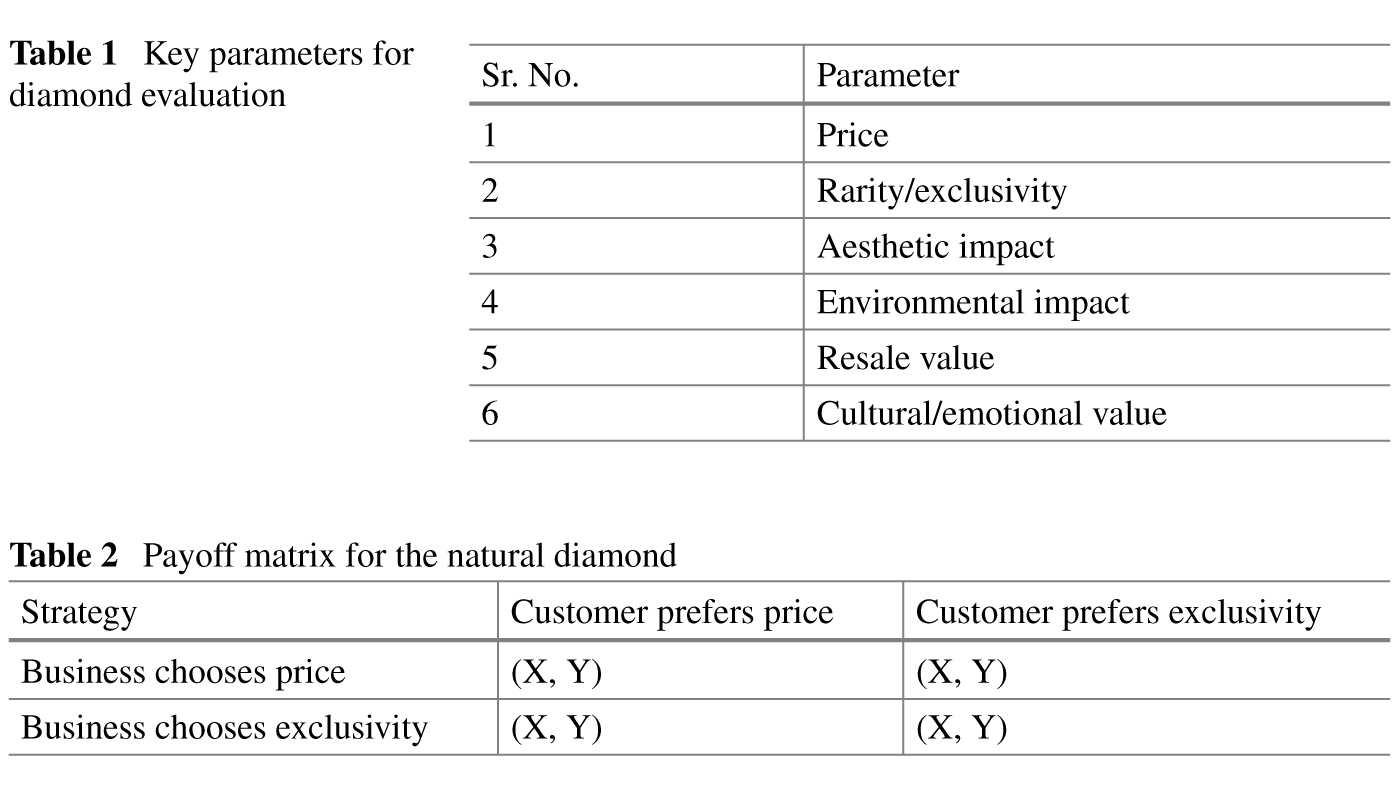
3.1 Identifying the Key Parameter As observed in the literature, two parties play a crucial role while creating the game theory model in the case of the diamond industry. These are the buyer and the seller. Where the two sides of the game are the natural-grown diamond and the lab-grown diamond. The manufacturing processes of both the diamonds are very different, and the other factors that affect them are different. The most influential factors that link both the diamonds are considered in Table 1. 3.2 Parameter Weighting Using the AHP (Analytical Herarchy Approach) Based on the literature review conducted in Sect. 2, the parameters mentioned in Table 1 are considered the most influential factors for both sellers and buyers in the diamond industry. It was also observed that these are the key parameters they assess when deciding to purchase either natural or lab-grown diamonds. The next step was to analyze the psychological perspective of both buyers and sellers to determine the approximate weightage they assign to these parameters during transactions. For this purpose, the AHP (Analytic Hierarchy Process) method was considered, as it assigns mathematical optimization-based weightage to the parameters. Since there are two parties involved (buyers and sellers) and two types of products (natural and lab-grown diamonds), two separate AHP analyses were conducted: one for business owners considering the sale of both natural and lab-grown diamonds and another for buyers considering the purchase of either type, Fig. 1 show the Flow chart of the AHP. 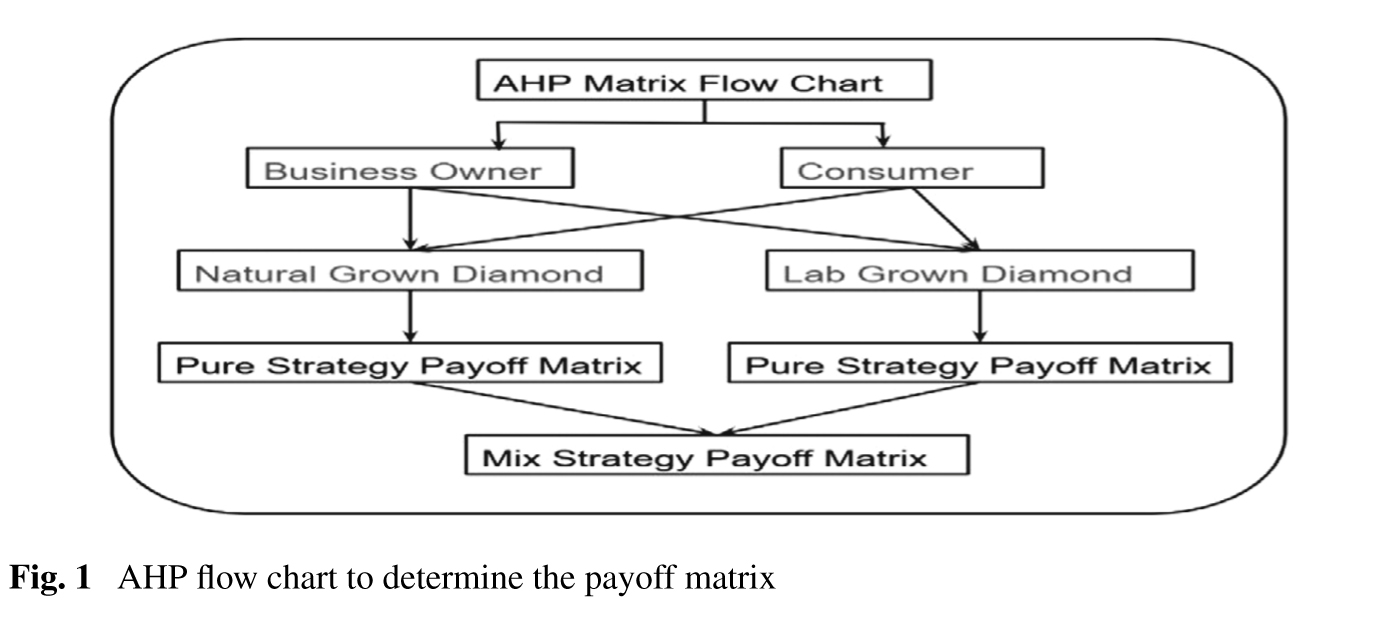
3.3 Constructing the Payoff Matrix As shown in Table 2, initially, two separate approaches were conside for the natural and the lab-grown diamond, and once the results from both were observed, the mixed approach was used. Table 2 shows the payoff matrix form in the case of the natural diamond. The Raw element shows the strategy followed by the business, and the column element shows the strategy followed by the consumer; however, the “X” and “Y” will be the weightage from both the parties coming from the calculation of the AHP. Using the same step, the payoff matrix for the lab-grown diamond was also created. Table 3 shows the Payoff matrix for the lab-grown Diamond. It was observed that in both the cases, pierce is one of the prime considerations where as, in case of the natural exclusivity was given the preference where as in case of the lab grow environmental impact was given the importances. Once the game theory model for both the diamonds is solved separately, a mixed payoff matrix considering both diamonds is formed. Table 4 shows the mixed payoff matrix used in the case of the natural and the lab-grown diamond. 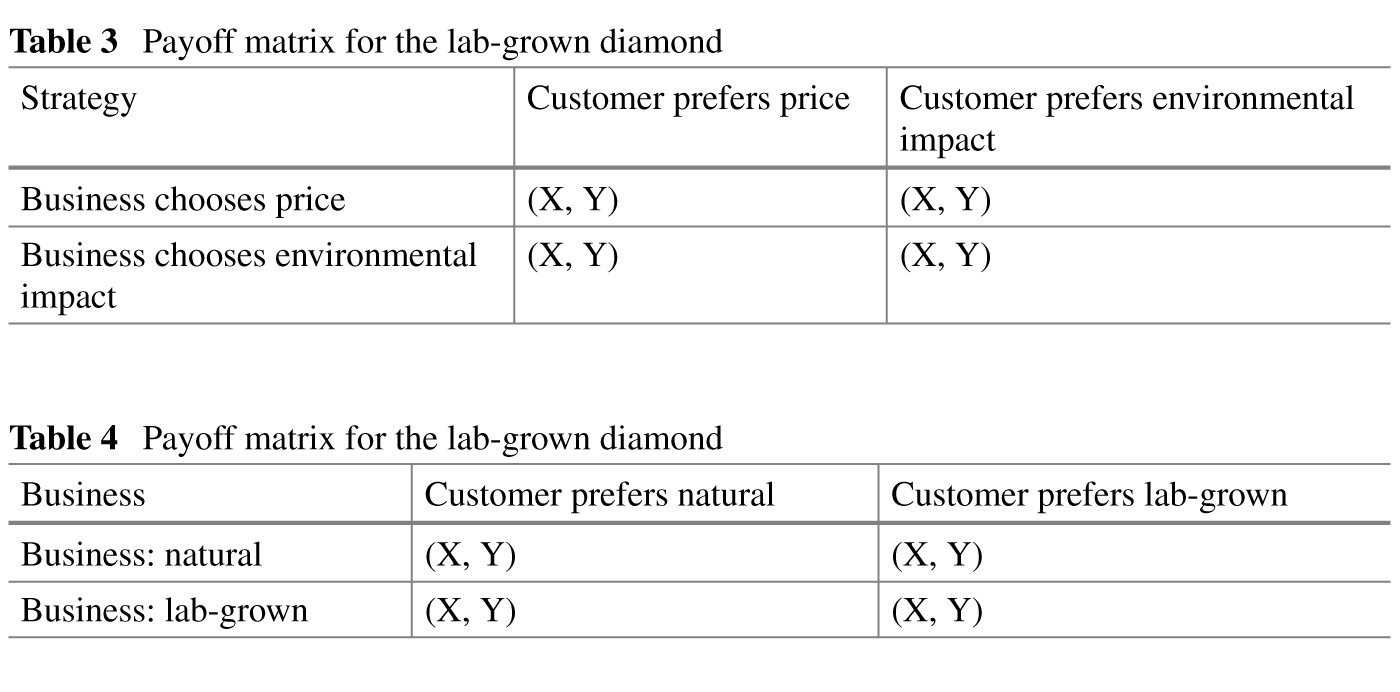
3.4 Game Theory Model Analysis Once the payoff matrix is created, the matrix is solved for the Nash equilibrium and to identify the optimum strategy in various cases: 4 Results and Discussion Based on the systematic methodology for the game theory analysis, the following results are observed. 4.1 Weightage from the AHP Based on the parameters decided, an AHP Matrix has been formed for the natural and lab-grown diamonds, and the statistical calculation has been carried out. Table 5 shows the final weightage for each parameter considered while creating the AHP matrix in the case of the natural diamond. In Table 5, considering the Price-focused column, the first value represents the business perspective, whereas the second value represents the consumer perspective. From Table 5, it can be observed that from the seller’s point of view, the price of the diamond receives higher weightage. However, considering the customer’s perspective, exclusivity holds greater importance. Keeping the same parameters in mind, the AHP analysis of lab-grown diamonds was also conducted, and the corresponding weightages are shown in Table 6. 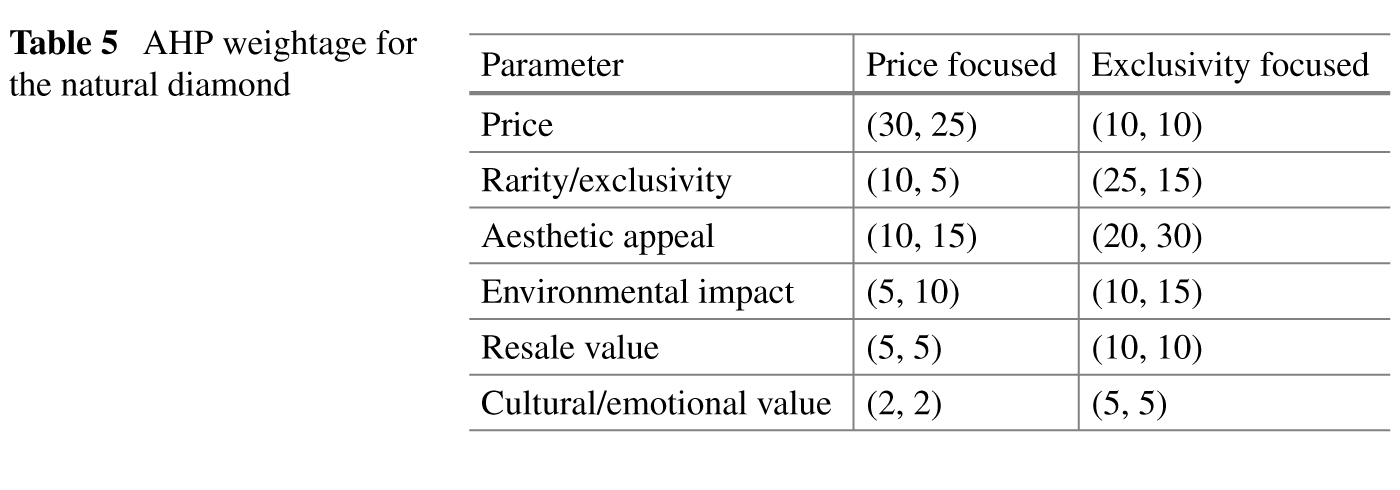
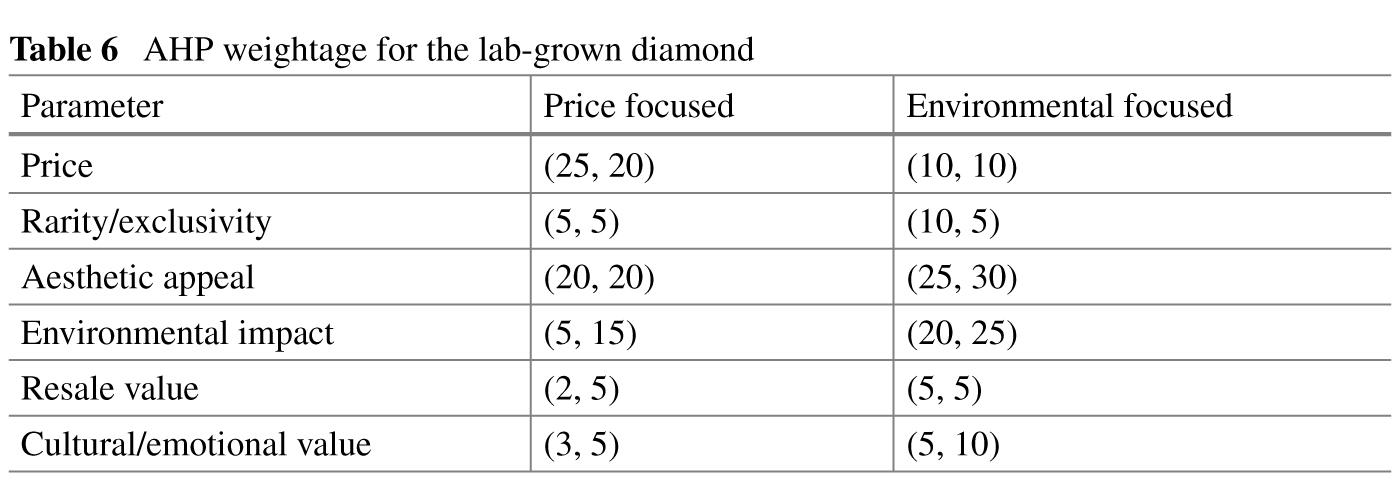
Looking at Table 6 for the lab-grown diamond, the weightage given to price is less than that given to the natural grown diamond, whereas the environmental impact received the maximum weightage. This shows the trend of the industry and the consumer in the natural and lab-grown market physiological shift due to two different factors, not the cost only. Based on the AHP weightage, a pay-off matrix for both the products has been calculated. Tables 7 and 8 show the payoff matrix for the natural diamond and the lab-grown diamond. From both payoff matrices, it was evident that businesses always focus more towards the price and the customer, towards the exclusivity and the environmental consideration. Furthermore, both the matrices were solved using the game theory approach to achieve the Nash equilibrium and, hence, to determine the best strategy for both the players. Observation are quite different and the same are menioed below. Considering the natural diamond only, the nash eqautilinirum said that, if both the party concentrate on the diamond exclusivity then business can enhance its minimum gain however customer can minimize its maximum loss. Whereas if we consider the lab grown diamond then both the party should concentrate on the environment as the important factor not the cost. 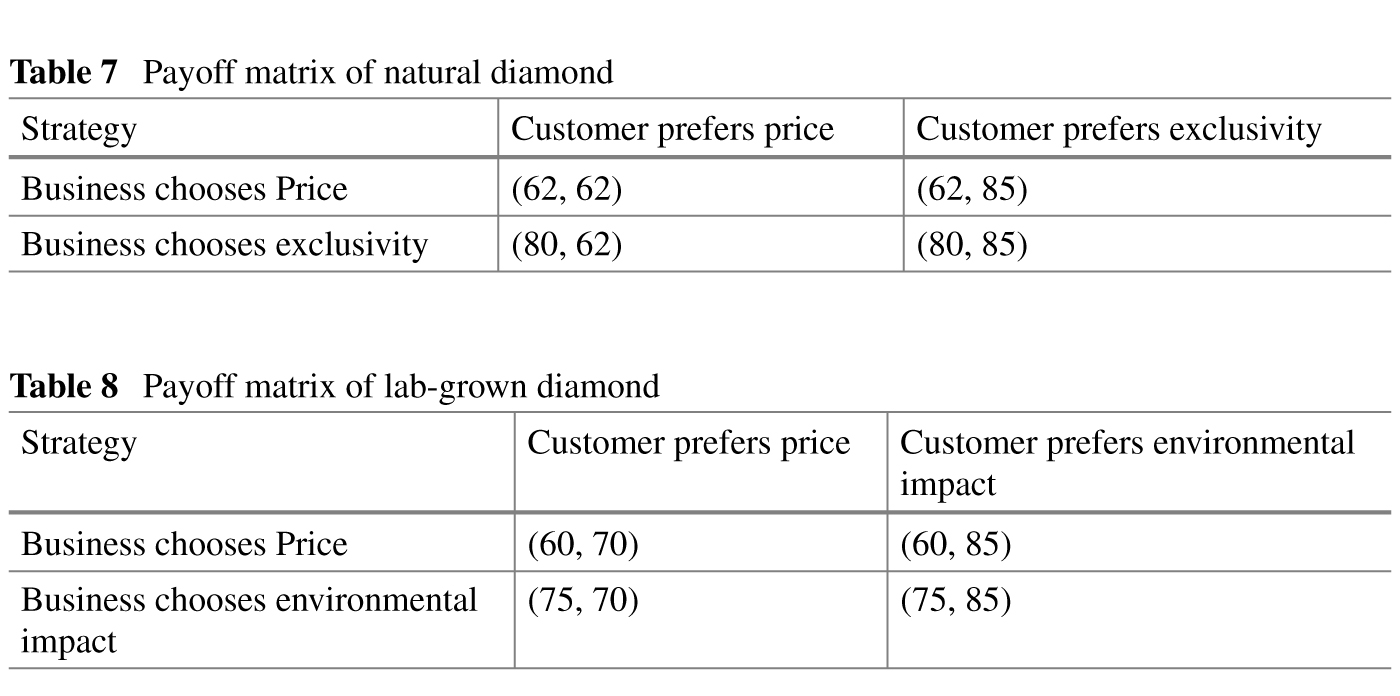
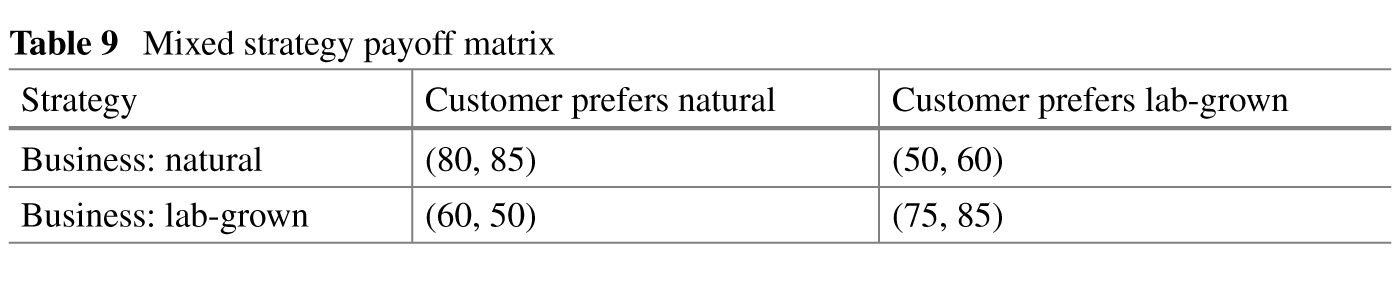
Based on the results of both diamonds, a new payoff matrix has been formed where both diamonds have been considered to determine the mixed strategy. Table 9 shows the Payoff Matrix table in case of the mixed strategy. From Table 9, it is evident that, as per the Nash equilibrium, the best strategy is that both should go for the natural diamond. However, if the customer mau move towqdrs the lab grw than even busines should move towards the lab gown diamond. This shows that both parties can either select and promote, but if any one wants tos shift then second also need to more towards that; this can be tackled by giving an equal amount of the sell by business in the market and lets wait the selection of the customer for the same. 5 Conclusion This work has shown how the diamond industry, particularly the competition between lab-grown diamonds (LGDs) and natural diamonds, is changing remarkably because of forced price changes, ethical issues, and business logic. The analysis with the game-theoretic approach shows that a Nash equilibrium is reached when LGD manu-facturers impose selective output control and brand name marketing, while the natural diamond firms decrease production to keep prices from falling too much. The find-ings mostly reveal that within the last year alone, the price of LGDs has decreased by almost 65%, which has resulted in a tremendous loss of consumer confidence and prowess to resale. In the same period, natural diamond prices, which were 34% higher in the jubilee months immediately after COVID, have now decreased due to excess supply, which brings about strategic negations of loss, urging levers to deny negative price competition. The AHP model constructed for this study has collected the values of consumers, which showed the highest sensitivity for LGD purchase as price as well as the value ethics in context. With these findings, policymakers and other players concerned with the market should take note if they wish to save the market and maximize profits. Future research should focus on integrating macroeconomic variables and machine learning-based predictive models to enhance strategic decision-making for diamond firms. Additionally, analyzing regulatory policies and consumer behavior trends can provide deeper insights into the evolving market equilibrium. |
||