| Home Top Stories Exclusive Events & News Brand Profile | ||
|
Industry welcomes duty cut for lab-grown diamonds raw material The government has taken some steps towards the betterment of this completely ‘Atma Nirbhar’ industry with a lot of export potential. Making it indigenious to India and making sure it grows is a very important step," said Smit Patel, convener of the LGD panel of the Gem & Jewellery Export Promotion Council (GJEPC). The industry generates a lot of jobs and has the potential to grow four times its current size, said Patel, director of Surat-based Greenlab Diamond.
"Most of the imports are from China, but Surat is becoming a hub for lab grown diamonds as well. The governments move will give a new boost to the fledgling industry," he said Surat in south Gujarat polishes 90 per cent of the world’s diamonds. While natural rough diamonds are the main staple for the majority of units located in the city, several units have also started polishing LGDs, Navadiya said. Lab-grown diamonds are created through two processes – High Pressure High Indian Govt. To Grant 242 Cr to IIT Madras for LGD Research Indian Institute of Technology Madras (IIT Madras) will be provided a grant of ₹242 crore over a period of five years to undertake research on Lab-Grown Diamonds (LGD). This research will be focused on driving indigenisation of the LGD manufacturing process. Presenting the Budget 2023 on 1st February 2023, Smt. Nirmala Sitharaman, Hon’ble Finance Minister, Government of India, said, “Lab grown Diamonds is a technology and innovation-driven emerging sector with high employment potential. These environment-friendly diamonds have optically and chemically the same properties as natural diamonds. To encourage indigenous production of LGD seeds and machines and to reduce import dependency, a research and development grant will be provided to one of the IITs for five years.” As per a recommendation made by Department of Commerce, the research grant of ₹242 crore over a period of f i v e y e a r s t o I I T M a d r a s h a s b e e n approved.
The research grants will go towards various departments and research groups of the Institute that are involved in this field. IIT Madras has a rich history of undertaking cuttingedge and translational research with significant applications in industry and society. Elaborating on the work that would be taken up under this initiative, Prof. M.S. Ramachandra Rao, Department of Physics, IIT Madras, who will be the Principal Investigator for this initiative, said, “The India Centre for Lab Grown Diamonds (InCent-LGD) at IIT Madras was identified for this prestigious project based on our nearly two decades of work experience in diamond research wherein we have developed many technologies for industry, space and defence sectors. We are honoured to contribute to the initiatives of the Government of India to boost Research and Development efforts in diamond growth to make India #1 country in producing good quality diamond crystals.” Prof. M.S. Ramachandra Rao added, “The growing demand for lab-grown diamonds requires dedicated research to realise not only gem-quality diamonds but also to realise a plethora of electronic applications (5G/6G, magnetometry, thermal management, sensors and quantum technologies). The science and technology of diamond growth processes are complicated to understand, and most of the machines, especially HPHT (High Pressure High Temperature), are imported in India. Moreover, the reactor manufacturers do not provide recipes to realise single crystal diamonds.” The global diamond market demands bigger and high pure lab-grown diamond crystals for commercial and electronic applications. There is a need for research and development to conduct systematic studies to optimize the process parameters to grow high pure large-volume and scalable diamond crystals, which will help India to become the world leader in lab-grown diamonds. India has no know-how in high pressure high temperature (HPHT) technology to grow and treat diamond crystals. The cost involved in importing HPHT machines is very high. Therefore, there is a need for developing indigenously built HPHT equipment and establishing the process know-how of HPHT diamond growth. On the other hand, CVD reactor manufacturers in India import critical components like microwave generators, vacuum pumps, and sensors. Even good-quality diamond seeds are imported. There is a need for indigenously developing these critical components, technologies and seed substrates (mother-seed) to make India selfsustainable in the lab-grown diamond sector. This is the requirement that the IIT Madras Research Group headed out to tackle.
|
||
 The budget
proposals aimed at
encouraging the
production of lab-grown
diamonds (LGD)
including an import duty
cut for the raw material
will help create a self
reliant diamond industry.
The Budget presented by
Finance Minister Nirmala
Sitharaman addressed a
major concern of the LGD
industry regarding the 5 percent import duty on the ‘seeds’
used in the production.
The budget
proposals aimed at
encouraging the
production of lab-grown
diamonds (LGD)
including an import duty
cut for the raw material
will help create a self
reliant diamond industry.
The Budget presented by
Finance Minister Nirmala
Sitharaman addressed a
major concern of the LGD
industry regarding the 5 percent import duty on the ‘seeds’
used in the production. 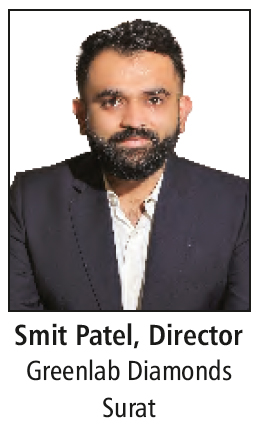 "Growers of LGDs outside India did not have to pay any
import duty on seeds, and it was detrimental for Indian
growers to pay such a duty. Growing (diamonds) in India is
important...This technology has a lot more potential in the
future, so if IITs help us make the process cheaper and
faster, it will be a very big boost for the industry," he added.
The seeds used to grow diamonds will now be treated at par
with rough diamonds which are already exempted from
import duty, said Vijay Mangukiya, Regional Chairman,
GJEPC, Gujarat .The GJEPC had also requested the
government to abolish import duties on the machinery used
in the manufacturing of lab-grown
diamonds, he added. Surat-based
diamond industry leader Dinesh
Navadiya said LGD manufacturing is
slowly increasing in India, and an
estimated Rs 10,000 crore-worth cut
and polished diamonds exported last
financial year had been grown in the
country.
"Growers of LGDs outside India did not have to pay any
import duty on seeds, and it was detrimental for Indian
growers to pay such a duty. Growing (diamonds) in India is
important...This technology has a lot more potential in the
future, so if IITs help us make the process cheaper and
faster, it will be a very big boost for the industry," he added.
The seeds used to grow diamonds will now be treated at par
with rough diamonds which are already exempted from
import duty, said Vijay Mangukiya, Regional Chairman,
GJEPC, Gujarat .The GJEPC had also requested the
government to abolish import duties on the machinery used
in the manufacturing of lab-grown
diamonds, he added. Surat-based
diamond industry leader Dinesh
Navadiya said LGD manufacturing is
slowly increasing in India, and an
estimated Rs 10,000 crore-worth cut
and polished diamonds exported last
financial year had been grown in the
country.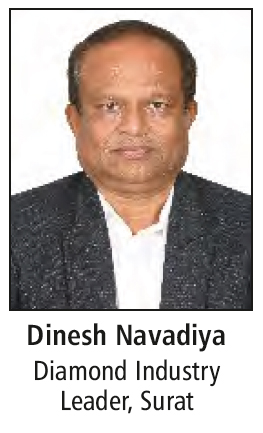 Temperature (HPHT), which is prevalent in China, and
Chemical Vapor Deposition (CVD). In her budget speech,
Finance Minister Nirmala Sitharaman said that with the
depletion of deposits of natural diamonds, the industry is
moving towards LGD and it holds huge promise. She
proposed to reduce basic customs duty on seeds used in their
manufacture. She also said that one of the Indian Institutes
of Technology (IITs) will be provided a research grant for
five years to encourage indigenous production of LGDs.
Temperature (HPHT), which is prevalent in China, and
Chemical Vapor Deposition (CVD). In her budget speech,
Finance Minister Nirmala Sitharaman said that with the
depletion of deposits of natural diamonds, the industry is
moving towards LGD and it holds huge promise. She
proposed to reduce basic customs duty on seeds used in their
manufacture. She also said that one of the Indian Institutes
of Technology (IITs) will be provided a research grant for
five years to encourage indigenous production of LGDs.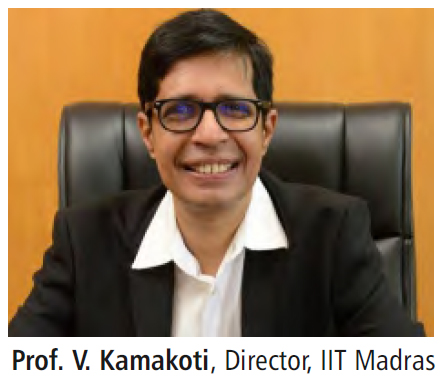 Thanking the Hon’ble
Finance Minister Smt.
Nirmala Sitharaman,
Prof. V. Kamakoti,
Director, IIT Madras,
said, “This is indeed
the right time to set up a
diamond factory in
India, given that diamonds have thermal and electrical
properties making it superior to contemporary technologies
like silicon, silicon carbide and gallium nitride. IIT Madras
will work towards producing diamond wafers suitable for
electronic applications. It is a historic moment for IIT
Madras for being selected for implementation of such an
important project, output of which will be a crucial
component of Atmanirbhar Bharat.”
Thanking the Hon’ble
Finance Minister Smt.
Nirmala Sitharaman,
Prof. V. Kamakoti,
Director, IIT Madras,
said, “This is indeed
the right time to set up a
diamond factory in
India, given that diamonds have thermal and electrical
properties making it superior to contemporary technologies
like silicon, silicon carbide and gallium nitride. IIT Madras
will work towards producing diamond wafers suitable for
electronic applications. It is a historic moment for IIT
Madras for being selected for implementation of such an
important project, output of which will be a crucial
component of Atmanirbhar Bharat.”